To move beyond subjective observation, I designed a cross-industry survey (N = 126) to understand:
- How they currently using AI
- how they perceive AI-generated content
- how they imagine AI’s future role in creative work
Participants include students, creative practitioners, cultural workers, and professionals in technology and public service—forming a diverse, interdisciplinary sample.
Due to network issues, the survey was distributed through two links, yielding 126 valid responses:
- GoogleForm https://docs.google.com/forms/d/e/1FAIpQLSd0GObpWJY665M37agr40t3SyMj4Z4iXiBkDSxlbFRxz8arbA/viewform
- Wen Juan Xing
https://v.wjx.cn/vm/reL4hRL.aspx# - Questionnaire data
3. Survey Insights Report
3.1 Sample Overview (Q1)
- Total respondents: 126
- Occupations (merged Chinese/English responses):
- Students ~15%
- Science & Technology ~15%
- Finance ~12%
- Cultural & Entertainment ~18%
- Freelancers ~15%
- Public sector / Management / Healthcare: remaining distribution
- The sample spans both creative–cultural industries and technology–finance sectors, forming a cross-industry, knowledge-oriented respondent group.
3.2 Part 1 — AI Usage and Penetration (Q2–Q9)
Familiarity with AI (Q2)
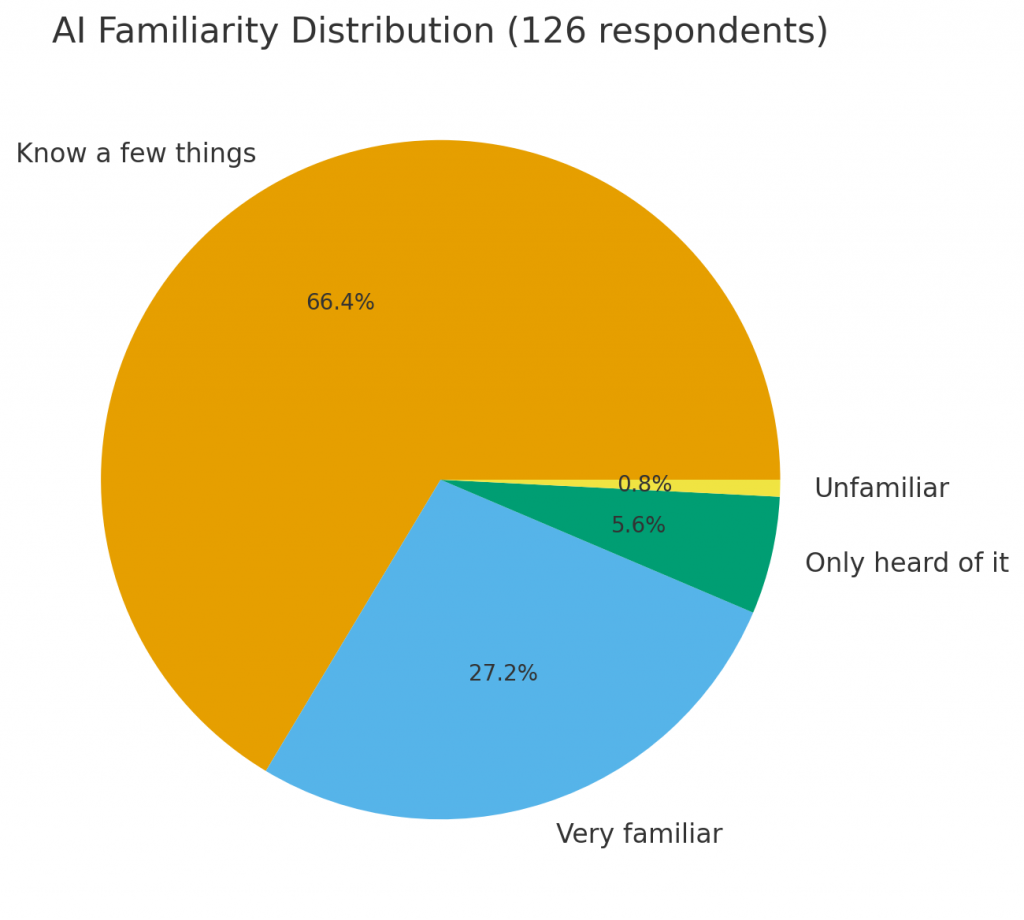
- Know a few things: 83 (65.9%)
- Very familiar: 34 (27%)
- Only heard of it: 7
- Unfamiliar: 1
Over 90% show some understanding; nearly one-third consider themselves “very familiar.”
AI usage (Q3) + frequency (Q5)
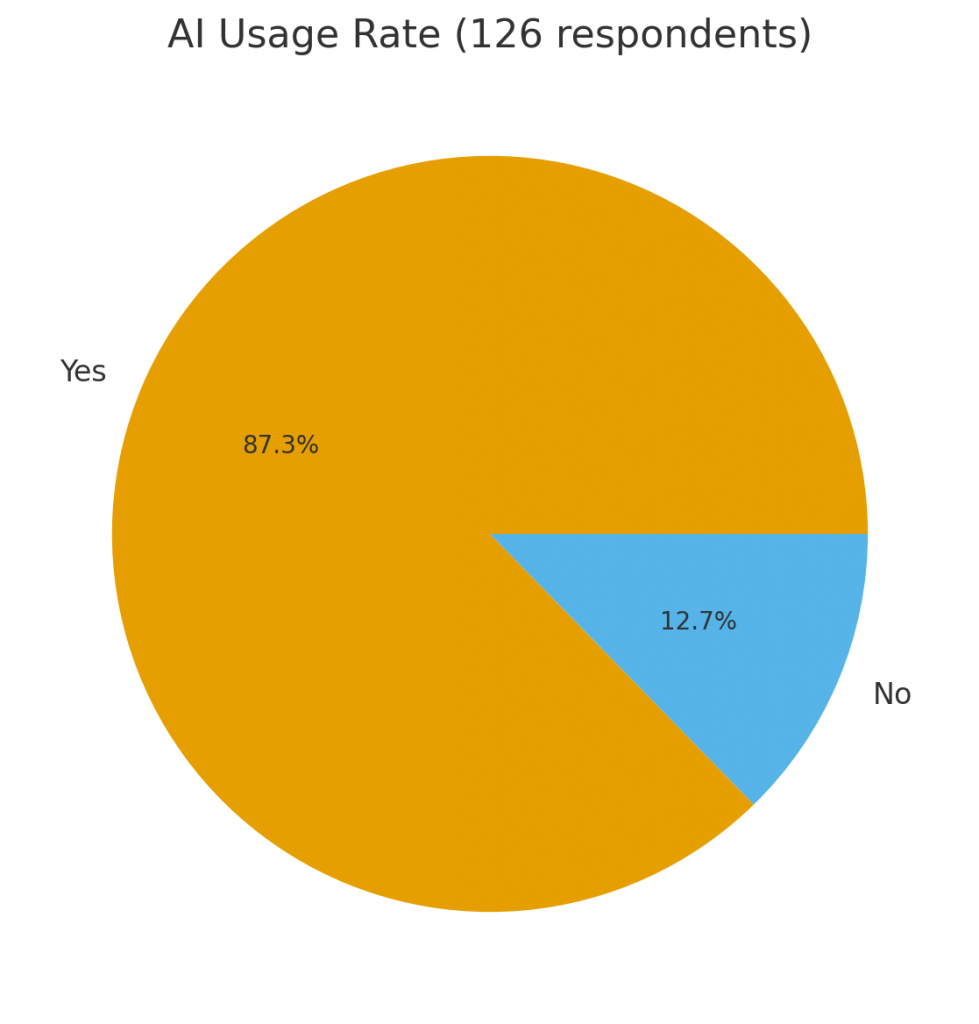
- Use AI tools: 110 (87.3%)
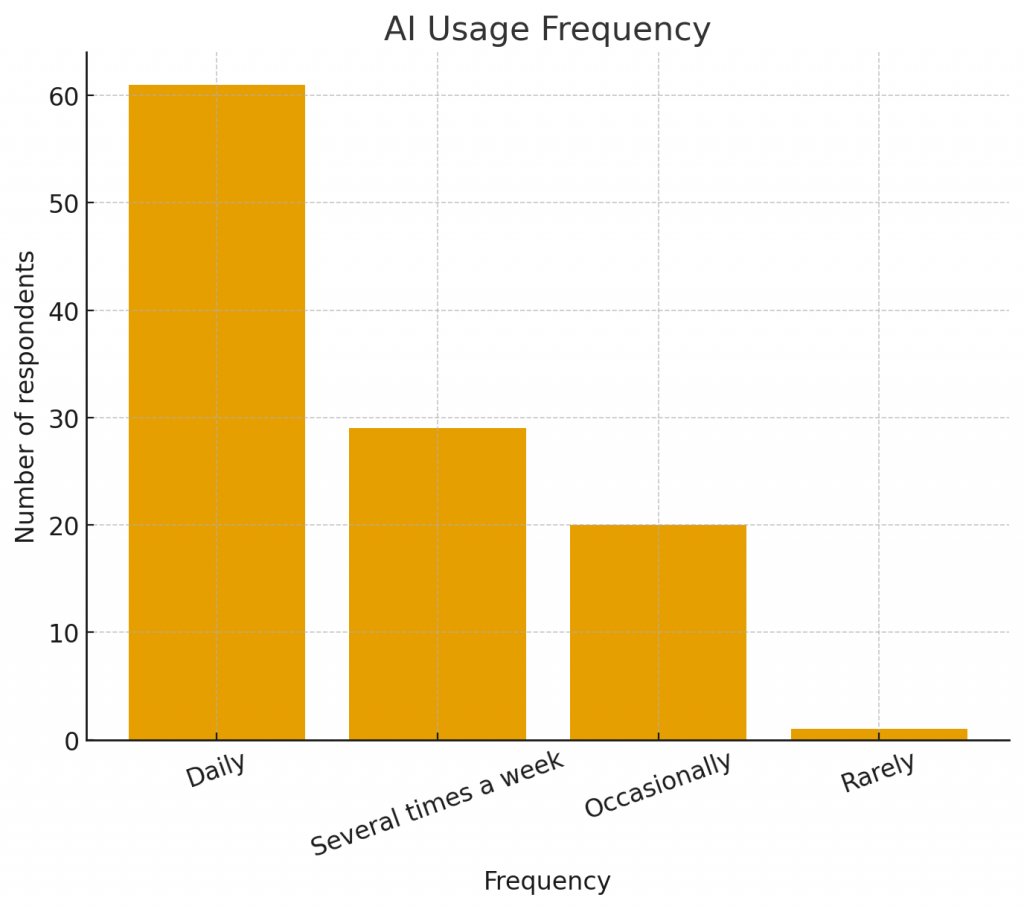
- Daily use: 61 (55%)
- Several times/week: 29 (26%)
- Occasionally: 20
- Rarely: 1
AI is already a daily basic tool, not an occasional novelty.
Preferred AI tools(Q4)
- Text-based AI: ChatGPT, Gemini, Claude
- Image-based AI: Midjourney, Firefly, Runway
- Productivity tools: Notion AI, Copilot
AI usage scenarios (Q6)
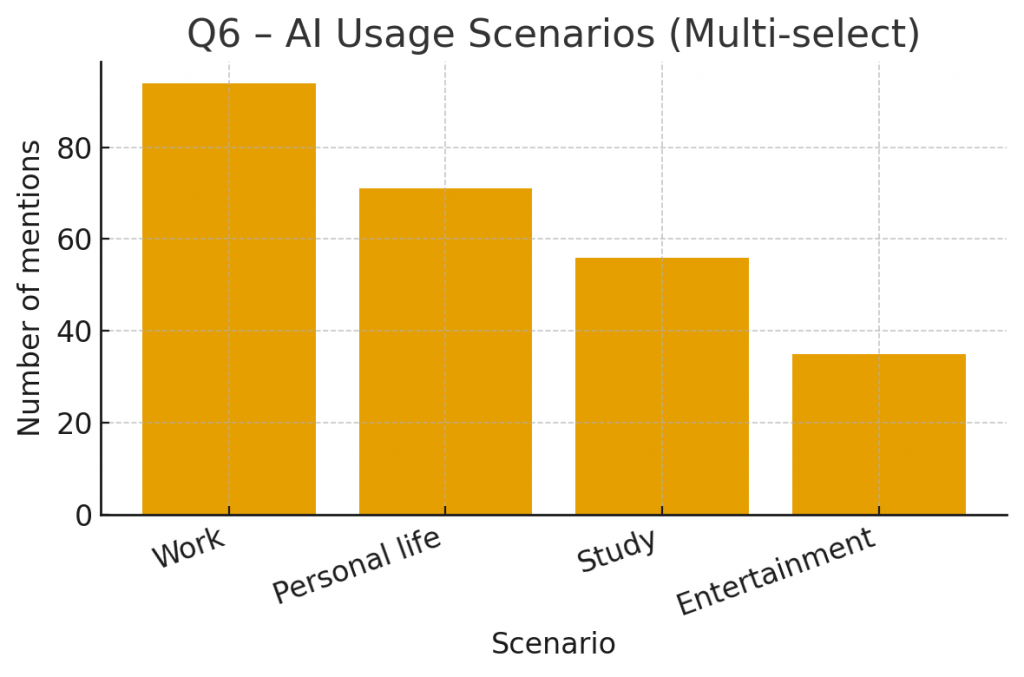
(Multiple choices >126)
- Work: 94 (74.6%)
- Personal life: 71 (56.3%)
- Study: 56 (44.4%)
- Entertainment: 35 (27.8%)
AI is embedded in both work and personal life, influencing decisions, organisation, and creativity.
Fields where AI is seen as most promising (Q7)
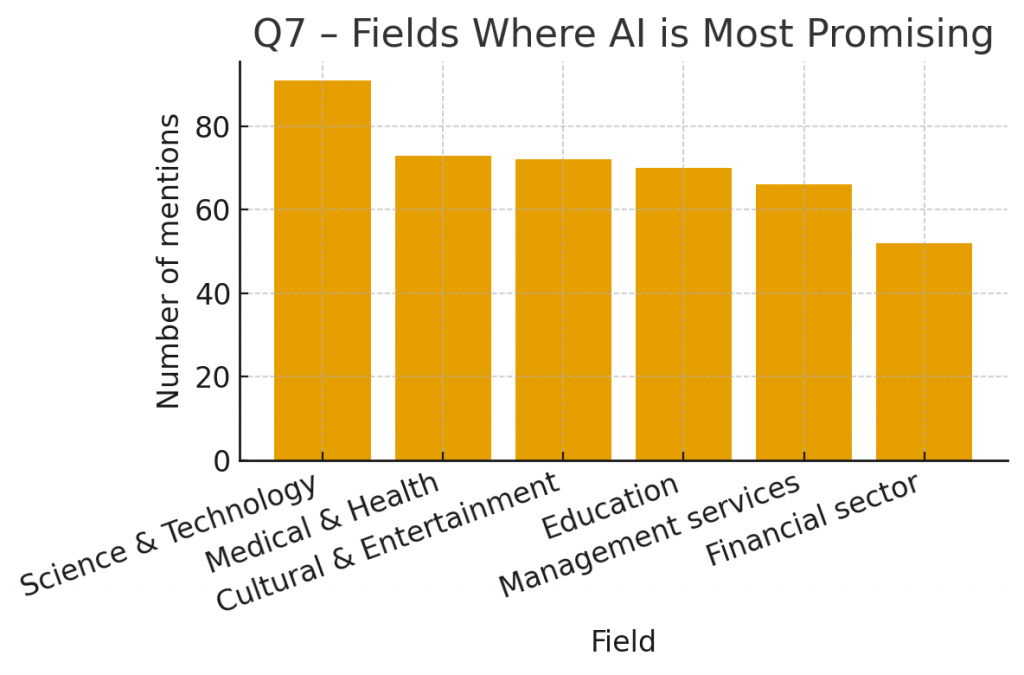
- Science & Technology: 91
- Medical & Health: 73
- Cultural & Entertainment: 72
- Education: 70
- Management services: 66
- Finance: 52
AI is viewed as infrastructure technology driving major sectors.
Perceived AI penetration (Q8) + societal impact (Q9)
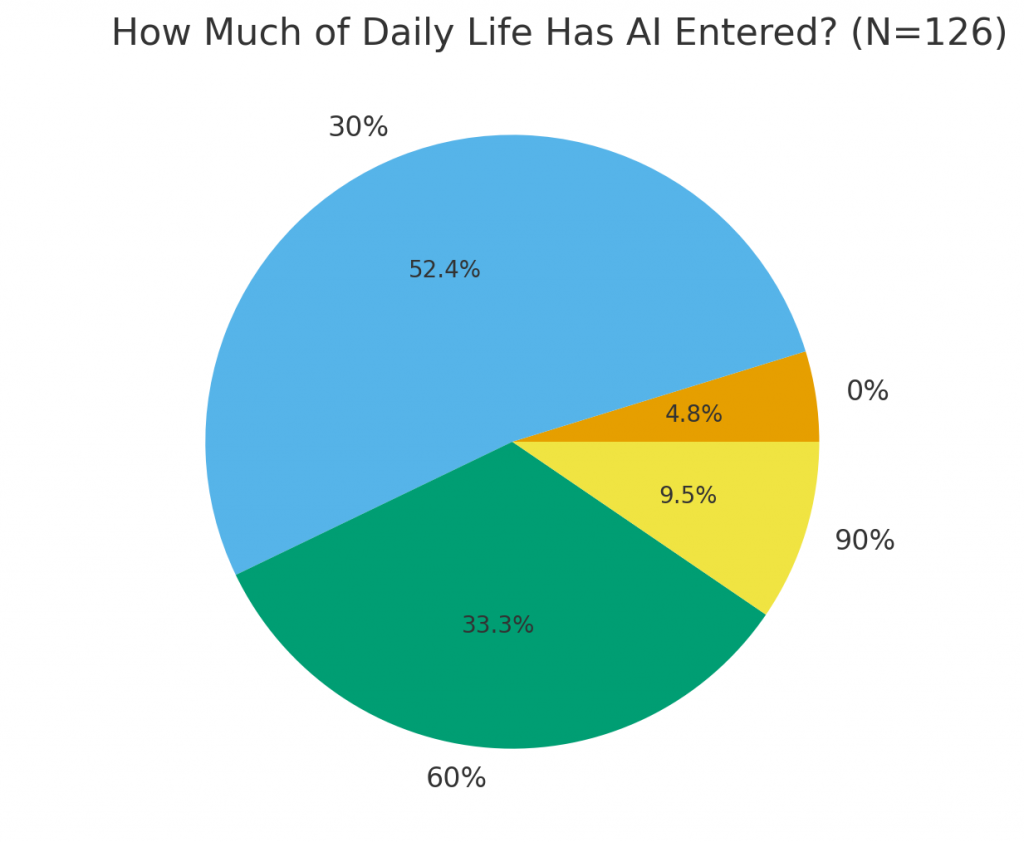
- AI penetration (30–60%): majority
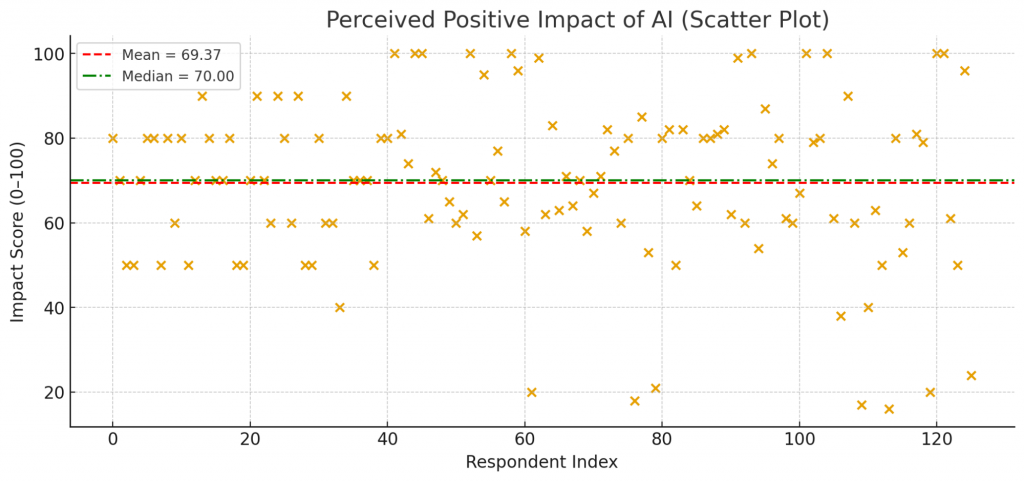
- Societal impact score: average ~69.4
Respondents believe AI’s benefits outweigh its risks, with cautious optimism.
Findings from Q2–Q9 demonstrate that AI functions as an everyday infrastructural technology, deeply integrated into the visual processing and decision-making systems of the general public.
3.3 Part 2 — Perception of AI-generated Content (Q10–Q12)
Awareness of AI-generated content (Q10)
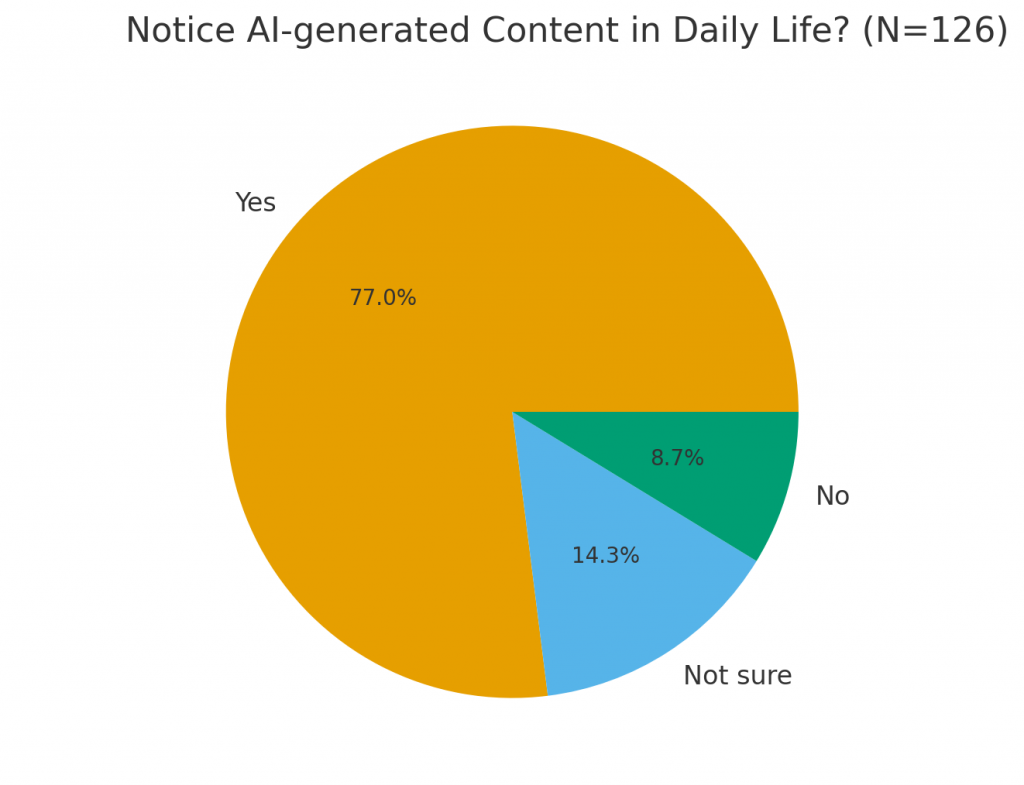
- Yes: 97 people (77.0%)
- Not sure: 18 people (14.3%)
- No: 11 people (8.7%)
People already widely recognize AI content in daily media.
Impressions of AI-generated visuals (Q11)
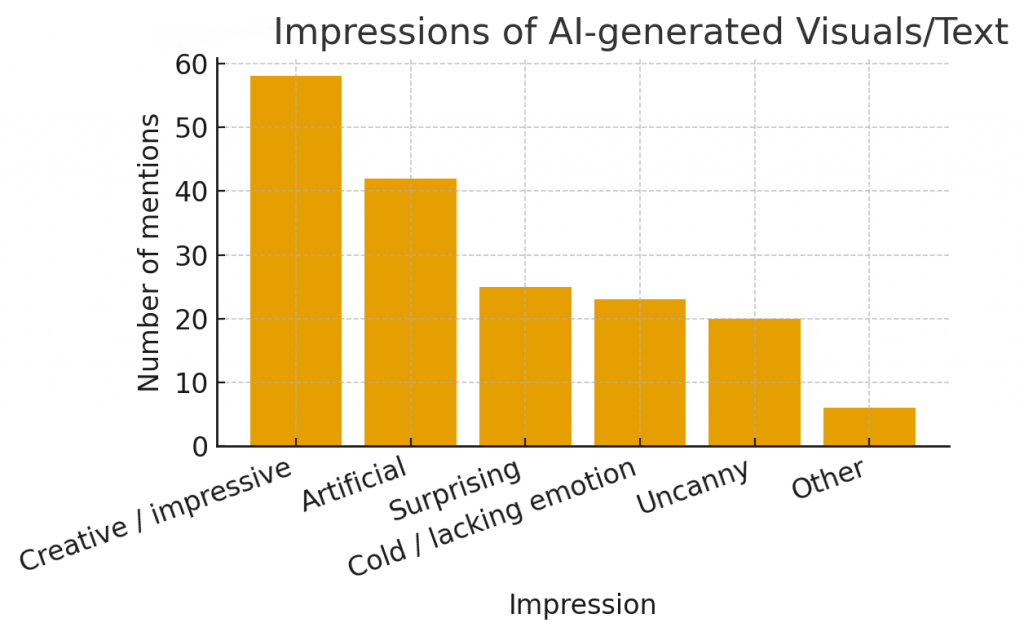
(Multiple choices)
- Creative/impressive: 58
- 人工:42
- Cold or lacking emotion: 23
- 不可思议:20
“Creative” and “artificial/cold” frequently co-exist, reflecting a duality between novelty and distrust.
Ability to distinguish AI (Q12)
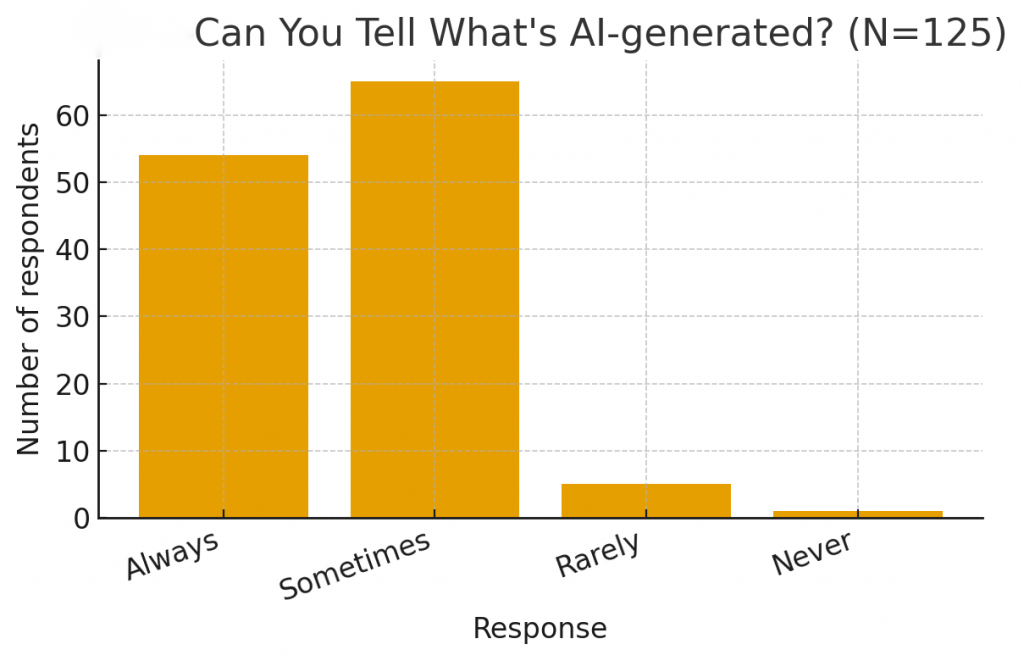
- Sometimes: 65
- Always: 54
Many believe they can identify AI content, though this confidence may be overly optimistic.
3.4 Part 3 — Attitudes toward AI and Future Roles (Q13–Q14)
Attitude toward AI becoming more pervasive (Q13)
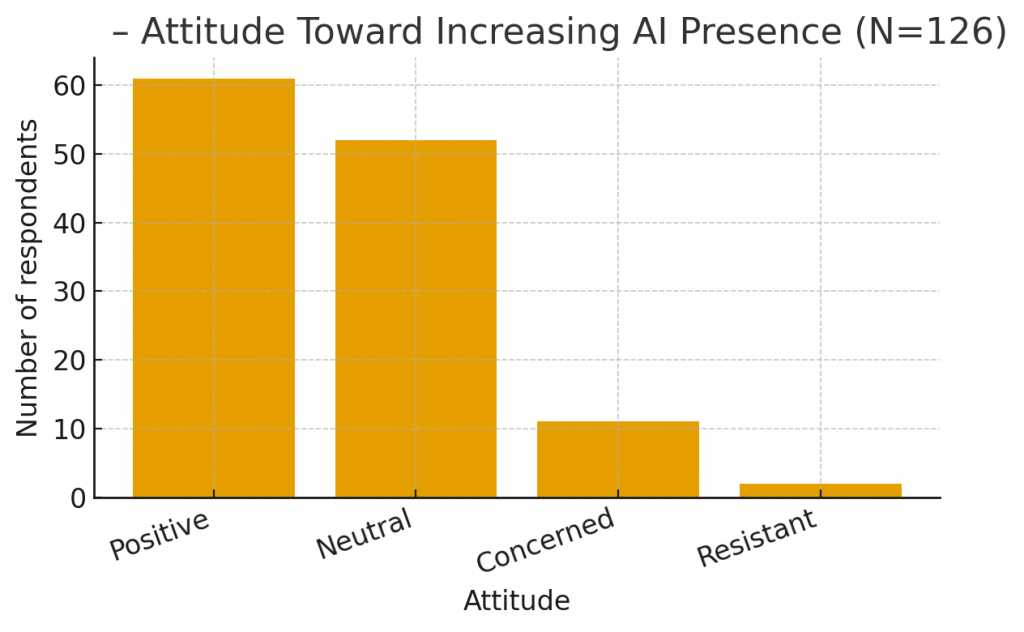
- Positive: 48.4%
- Neutral: 41.3%
- Concerned: 8.7%
AI is widely accepted, though people remain observant.
Role of AI in future creative work (Q14)
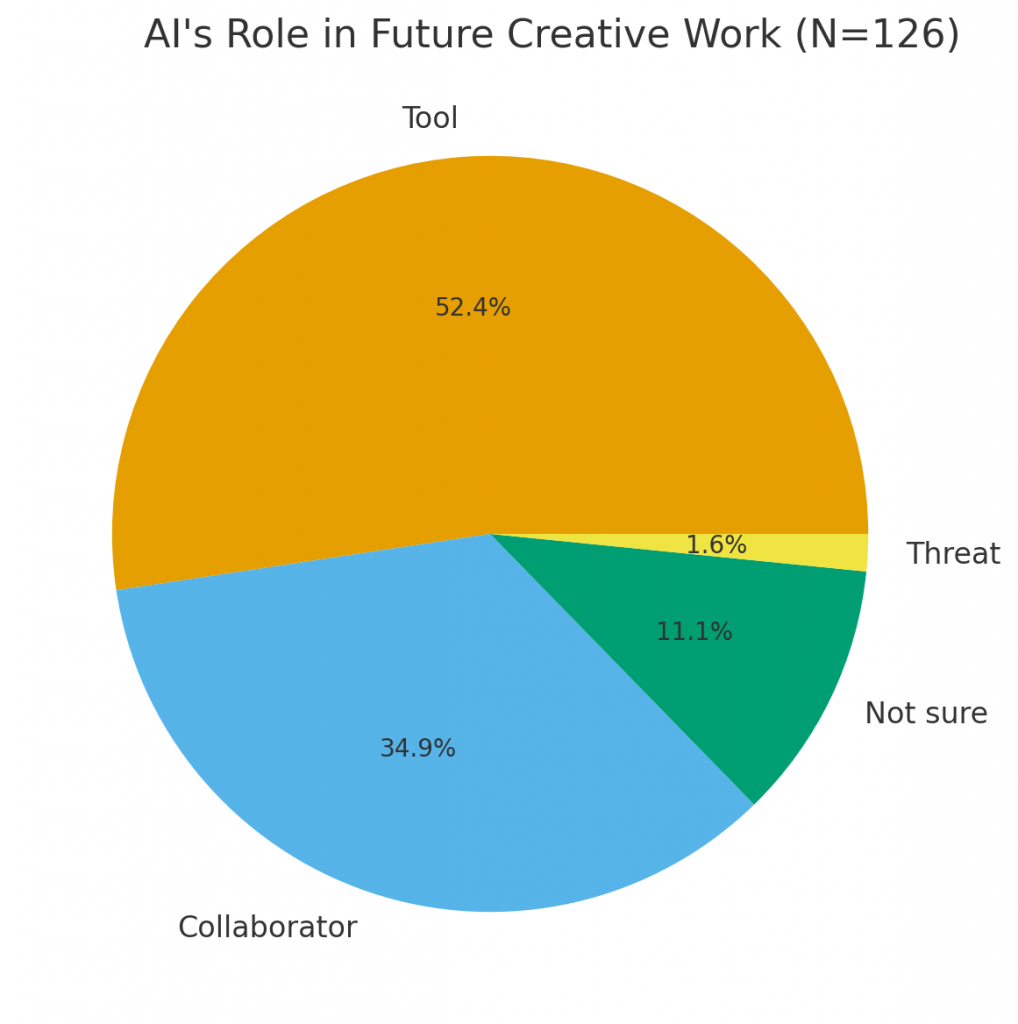
- Tool: 52.4%
- Collaborator: 34.9%
- Threat: 1.6%
The public favors human–AI co-creation, not replacement.
Overall Insights: What does this survey reveal?
1. AI has become a widely used everyday tool, especially in work and study contexts.
87% of respondents use AI, and 55% use it daily, indicating that AI has already been integrated into the daily routines of highly educated and knowledge-oriented groups.
2. The public holds a “cautiously accepting” attitude toward AI: recognising its convenience while remaining observant.
Nearly half express a positive attitude, while more than 40% remain neutral; although the proportion of concern is low, it is not insignificant.
3. Perceptions of AI-generated visuals show a dual impression of “creativity vs. artificiality.”
Many respondents find AI visuals creative, yet they also describe them as artificial, cold, or uncanny. There is no strong evidence of emotional resonance.
4. Most people believe they can distinguish AI-generated content, but this confidence may be subjective.
Many selected “always” or “sometimes,” but this does not necessarily reflect actual identification ability.
5. AI is viewed as a “tool” or “collaborator” rather than a replacement in future creative work.
More than 80% of respondents believe AI should serve as an assistive role, not as a threat.
Critical Reflection
In analysing the 126 samples, I realised that the prevalence of AI usage is far higher than I initially expected, yet perceptions at the emotional level have not developed at the same pace.
Most respondents rely on AI daily for work, study, and life tasks, suggesting that AI has become a foundational tool. However, when it comes to AI-generated visuals, their emotional responses are far more mixed:
on one hand, they appreciate AI’s creativity;
on the other, they feel it is “artificial,” “cold,” or even “uncanny.”
This made me understand that:
Widespread technological use ≠ emotional trust or resonance.
At the same time, although most respondents believe they can identify AI-generated content, this confidence may rely on subjective intuition rather than actual ability—highlighting the importance of transparency and explainability.
More importantly, although people generally accept AI, few believe it will fully replace creative work. This indicates a public expectation for AI to act as an augmenting force, not a replacing one.
Therefore, this survey makes it clear to me that the key challenge for AI in branding and consumer interaction does not lie in usage rates, but in the domains of emotional perception, trust-building, and the design of human–AI collaboration models.
Future research on AI visuals in branding should therefore focus on user expectations, perceptual differences, and emotional thresholds, not merely the technical capabilities of AI.
Leave a Reply