Based on the survey findings, I organised a structured open discussion (see figure1)to explore four core questions that emerged repeatedly in the data:
AI’s creativity, emotional expression, authenticity, and its influence on brands.
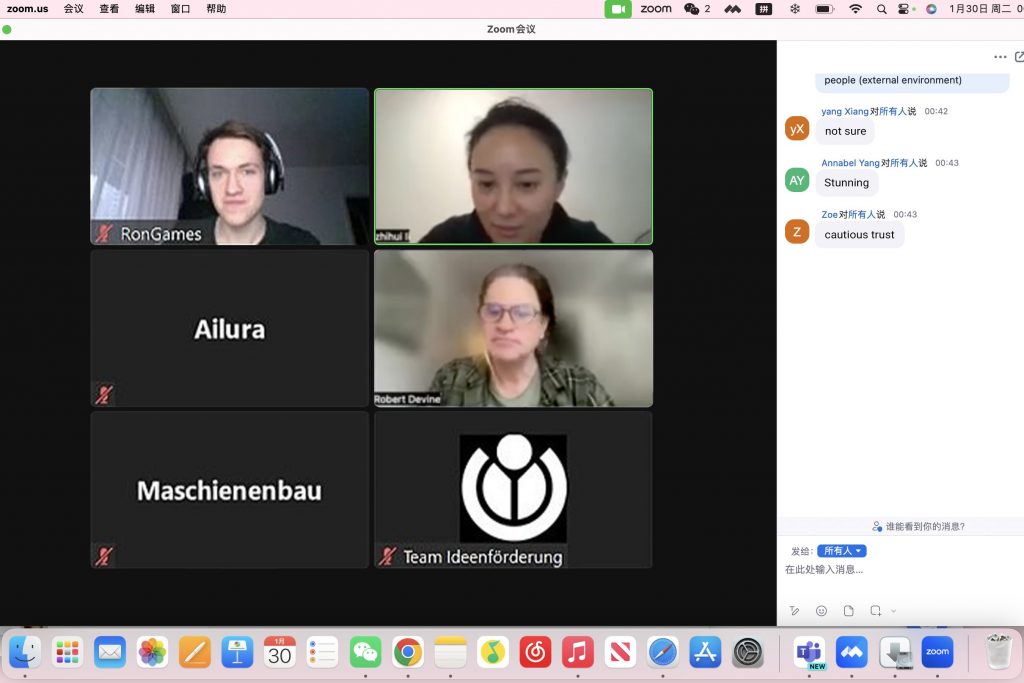
Figure 1 Open Discussion
While the survey offered patterns, the discussion exposed the tensions, contradictions, anxieties, and desires that numbers alone cannot show.
Below is a critically layered summary: not just what participants said, but what these comments reveal about our changing relationship with AI.
1. AI has quietly restructured people’s daily thinking and working habits
Critical Insight: The shift is cognitive—not just behavioural
Participants didn’t just “use” AI more; they described a cognitive dependence:
- Replacing Google/Baidu with AI as the first step for searching
- Using AI as a “second brain”
- Outsourcing structure, language, and sometimes even decision-making
- Creative workers turning AI into an always-on moodboard, editor, and generator
This raises a deeper question:
What happens when AI becomes the default organiser of human thought?
Not wrong—but worth interrogating.
AI is no longer an assistant; it has become a thinking environment.
2. AI-generated content is everywhere—and becoming invisible
Critical Insight: High exposure reduces awareness, not skepticism
People notice AI content daily:
social media, advertising, e-commerce, digital billboards, workplace documents.
But a paradox emerges:
The more AI content appears, the less people actively notice it—yet the more cautious they become.
This shows a cultural shift:
AI is becoming ambient.
Its presence is normalized, but its authenticity is doubted.
3. Trust exists—but only in a conditional, suspended form
Critical Insight: People trust AI functionally, but not emotionally
Participants’ trust can be summarized as:
“Useful, but I need to check.”
The tension is clear:
- They rely on AI outputs
- They don’t fully trust them
- They keep verifying while continuing to use them
This is neither trust nor distrust—it is pragmatic uncertainty.
A new psychological state created by AI.
4. AI expands creativity but cannot replace human depth
Critical Insight: AI amplifies imagination but flattens nuance
Strengths participants mentioned:
- High efficiency
- Breaking creative boundaries
- Low-cost experimentation
- Accessibility to non-experts
But limitations were deeper and more existential:
- Lack of lived experience
- Homogenised aesthetics (“same vibe everywhere”)
- Difficulty with cultural or emotional nuance
- Tendency to produce “shallow but pretty” results
This shows a fundamental distinction:
AI generates possibilities.
Humans generate meaning.
5. Brand × AI: curiosity, freshness, but also suspicion
Critical Insight: AI-generated brand visuals risk emotional disconnection
Participants often described brand uses of AI as:
- visually impressive
- innovative
- efficient
But also:
- insincere
- lazy
- emotionally distant
Here lies the brand challenge:
AI can elevate aesthetics but weaken authenticity.
People don’t dislike AI in branding;
they dislike when brands use AI without intention or emotional grounding.
6. Can AI express emotion? People say: “Only aesthetically, not genuinely.”
Critical Insight: AI conveys emotion as style, not as experience
Three perspectives emerged:
- “Yes—superficially.”
AI can express colour, tone, or atmosphere. - “No.”
Emotion requires lived experience and empathy. - “It depends on humans.”
AI is a tool; warmth comes from designers, contexts, and narratives.
Consensus:
AI can produce emotional signals,
but not emotional intent.
This is where human creators remain essential.
Summary
Across all themes, one pattern becomes clear:
**AI is expanding what people can do,
but revealing its limitations faster than expected.**
Participants describe AI as:
- everywhere
- useful
- impressive
- efficient
- but also artificial
- emotionally flat
- culturally shallow
- and spiritually empty
This doesn’t mean AI is failing.
It means humans are beginning to differentiate what AI can and cannot replace.
Reflection
These conversations made me realise that AI is not transforming creativity as much as it is transforming the conditions of creativity.
People work faster, think differently, rely more on external structure, but:
They still look for meaning, intention, emotional truth—things AI cannot produce on its own.
AI is becoming powerful, but its weaknesses are increasingly visible:
- It cannot feel
- It cannot intend
- It cannot own culture
- It cannot hold emotional responsibility
And this is exactly where future design, branding, and creative practice must intervene.
Not by rejecting AI,
but by designing how humans and AI co-shape meaning,
rather than letting AI flatten it.
Leave a Reply
You must be logged in to post a comment.